(Click to switch slides)
In mid 2024 I told Hannah about an idea I'd had. A kind of balloon that would be self-sustaining by using sunlight to create its own lifting gas, which in this case would be hydrogen. Hydrogen can be created simply from water and electricity through electrolysis. The balloon would collect its own rainwater along with electricity through solar panels. It would then use this electricity to split the water into hydrogen and oxygen. Theoretically this was totally possible, depending on the leakage of the envelope. We set about designing the balloon later that day.
Because neither of us had ever built a balloon, we decided to build a standard lifting gas balloon as a prototype first, but I insisted that we not compromise on the size of the envelope. We drew the shape of the envelope in a graphing calculator, going with a teardrop shape. We decided that the balloon would be 6 m long.
One of the books I was most interested in growing up was a set of images of the sculptures of Panamarenko. These included a number of blimps as well as balloons and other flying machines, propeller driven and gas driven, which all looked on first inspection like they might be some kind of working relic. They looked like realized creations from long-lost Da Vinci sketches. As a child, I didn't know anything about engineering and thought each one was functional. It was disappointing, and still is, to know they are just works of art.
We planned a day that we might prepare the materials and start work, deciding that we would use PVC heat welded together to create strong and flexible seams. After trying a number of nearby fabric shops, all of which were closed, we eventually figured out Dunelm sold 0.5mm thick PVC by the meter for a reasonable price. The only issue was the limited quantity kept in stock by each shop.
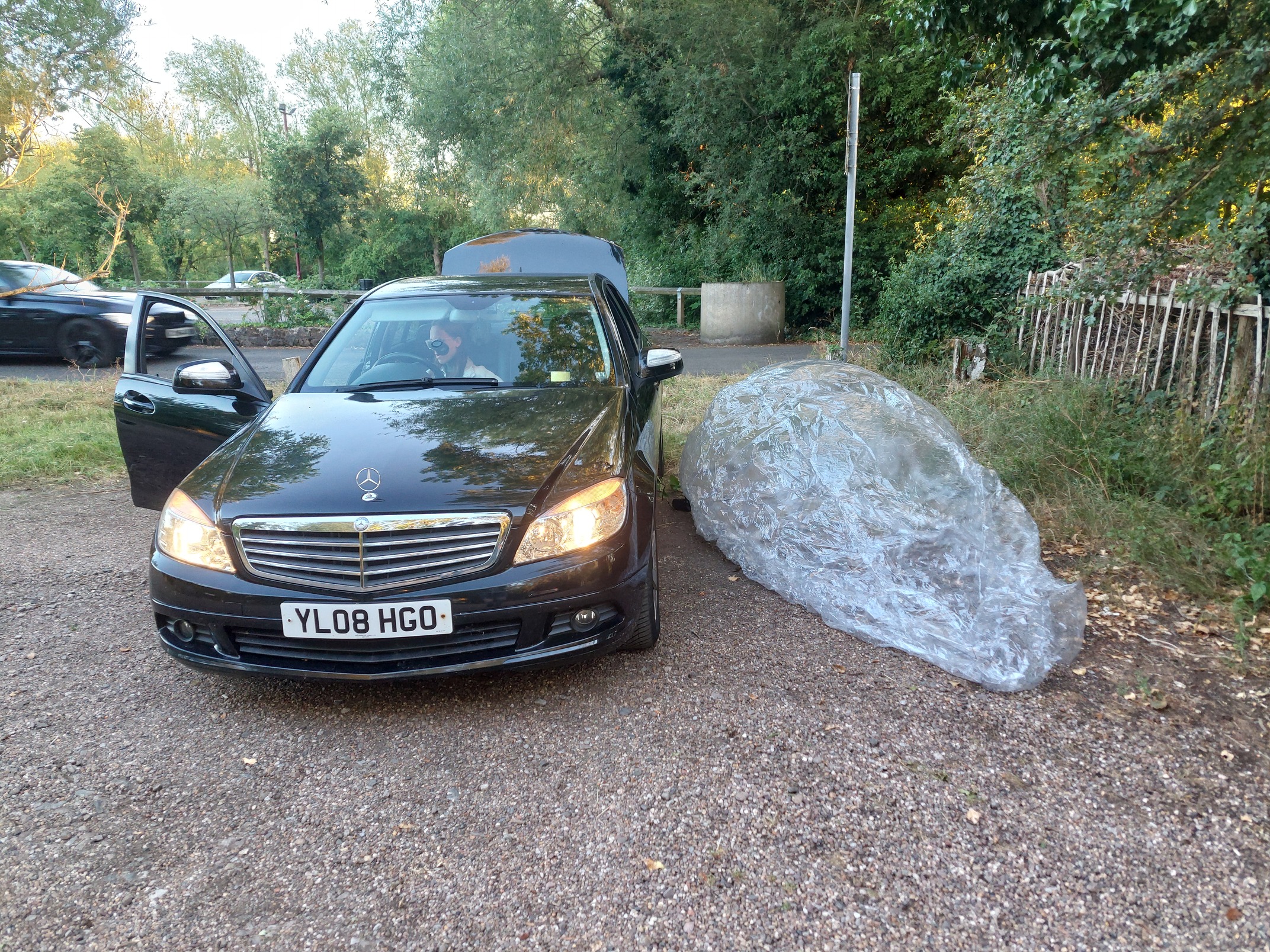
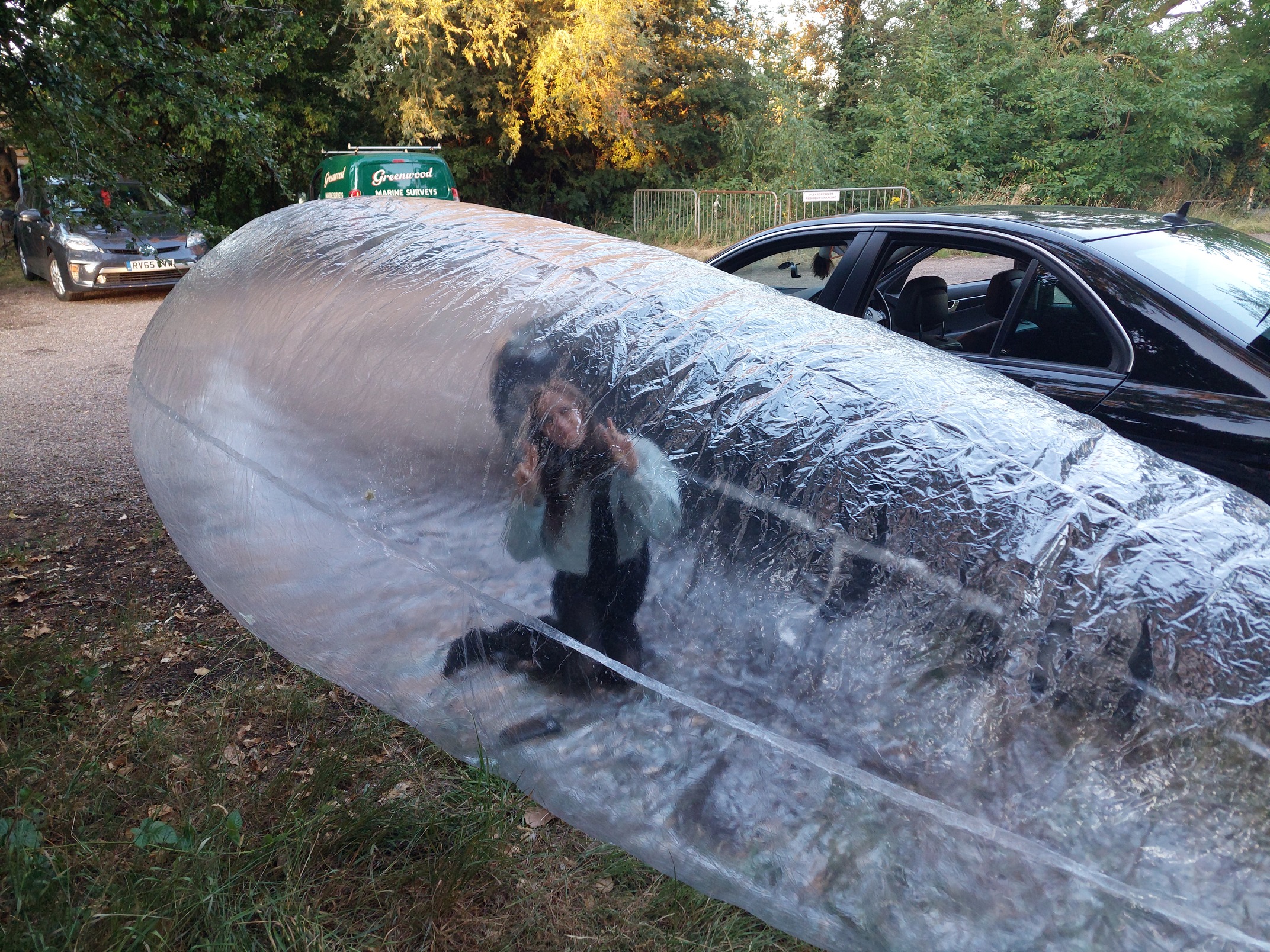
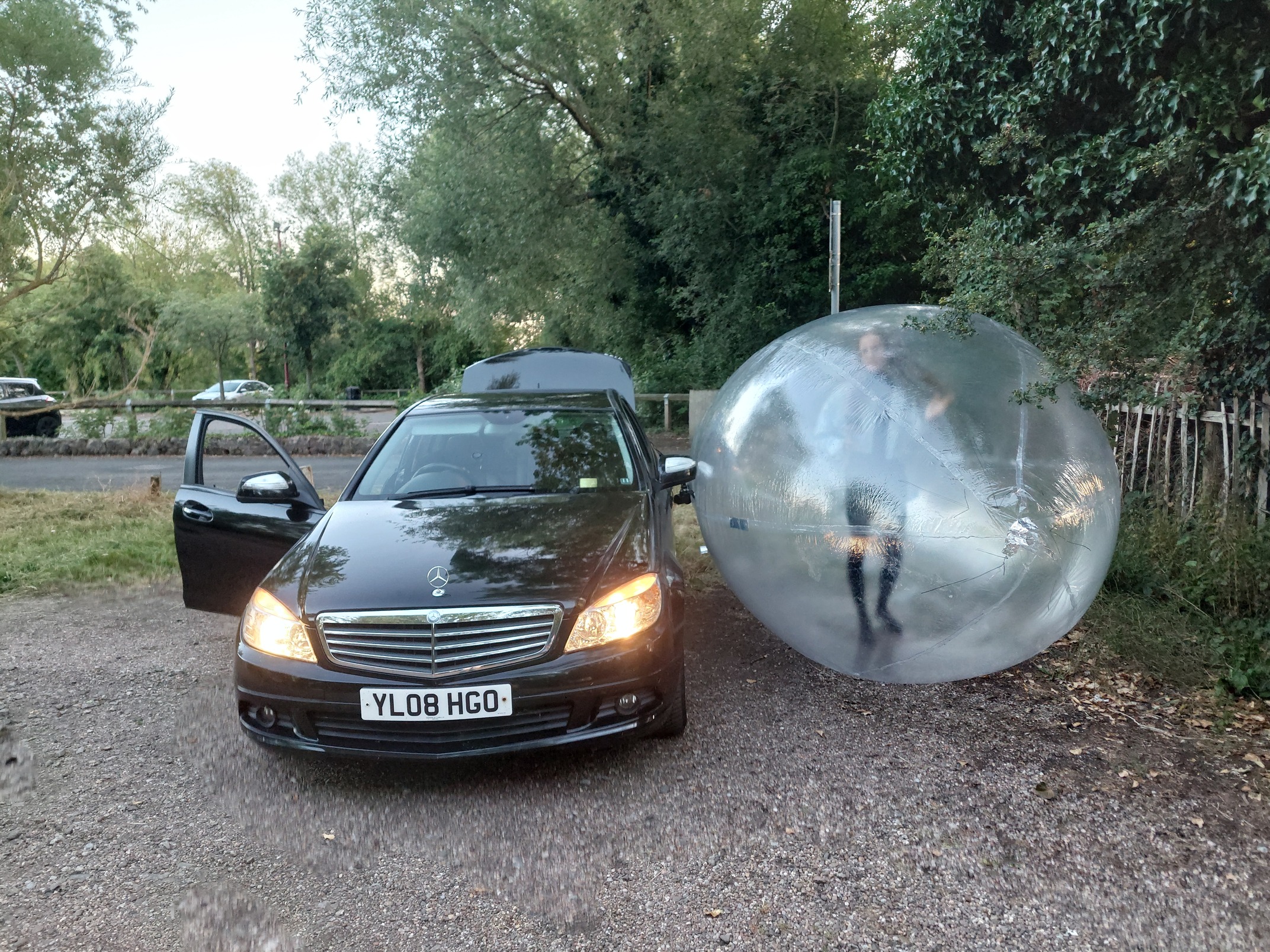
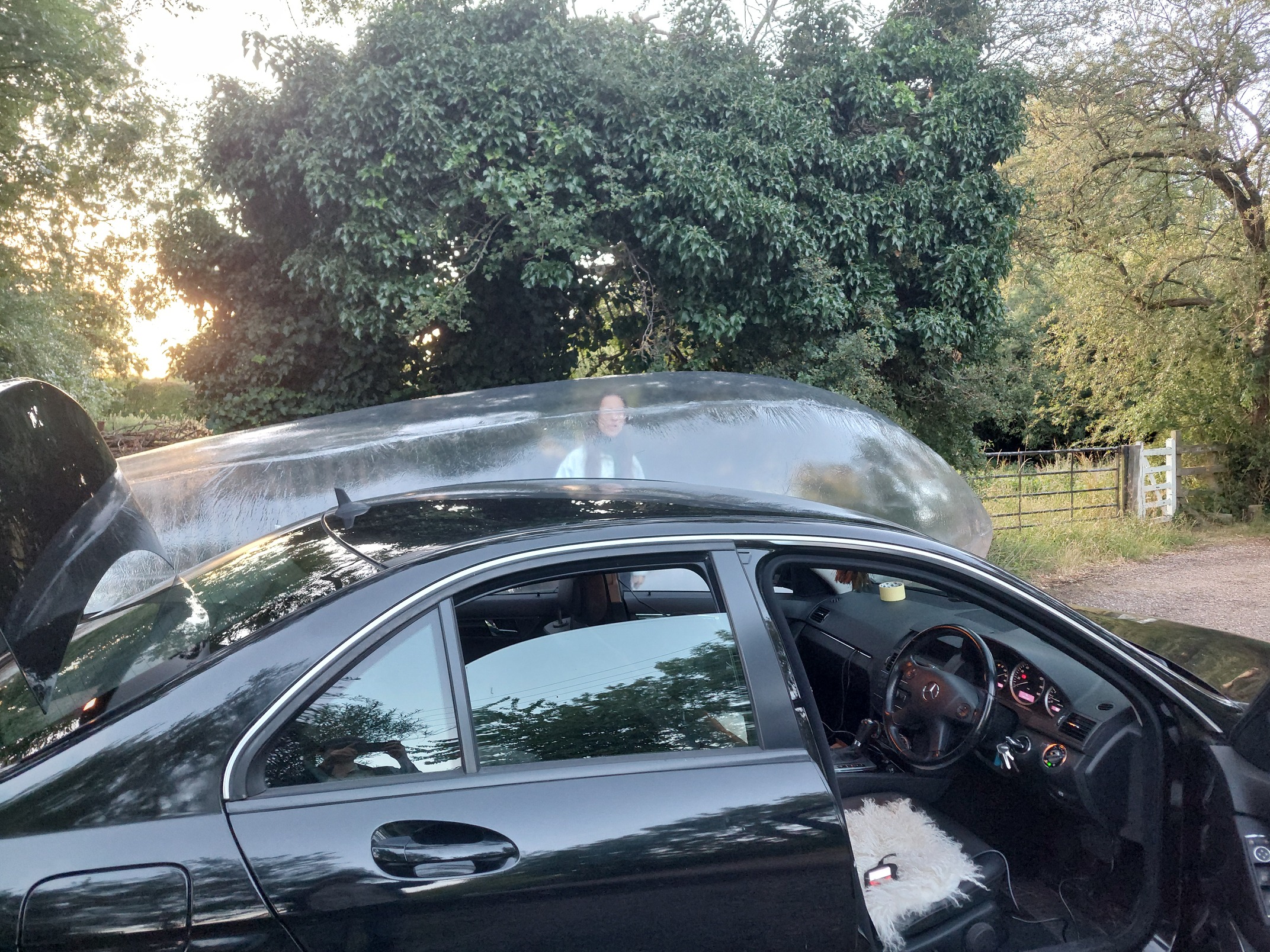
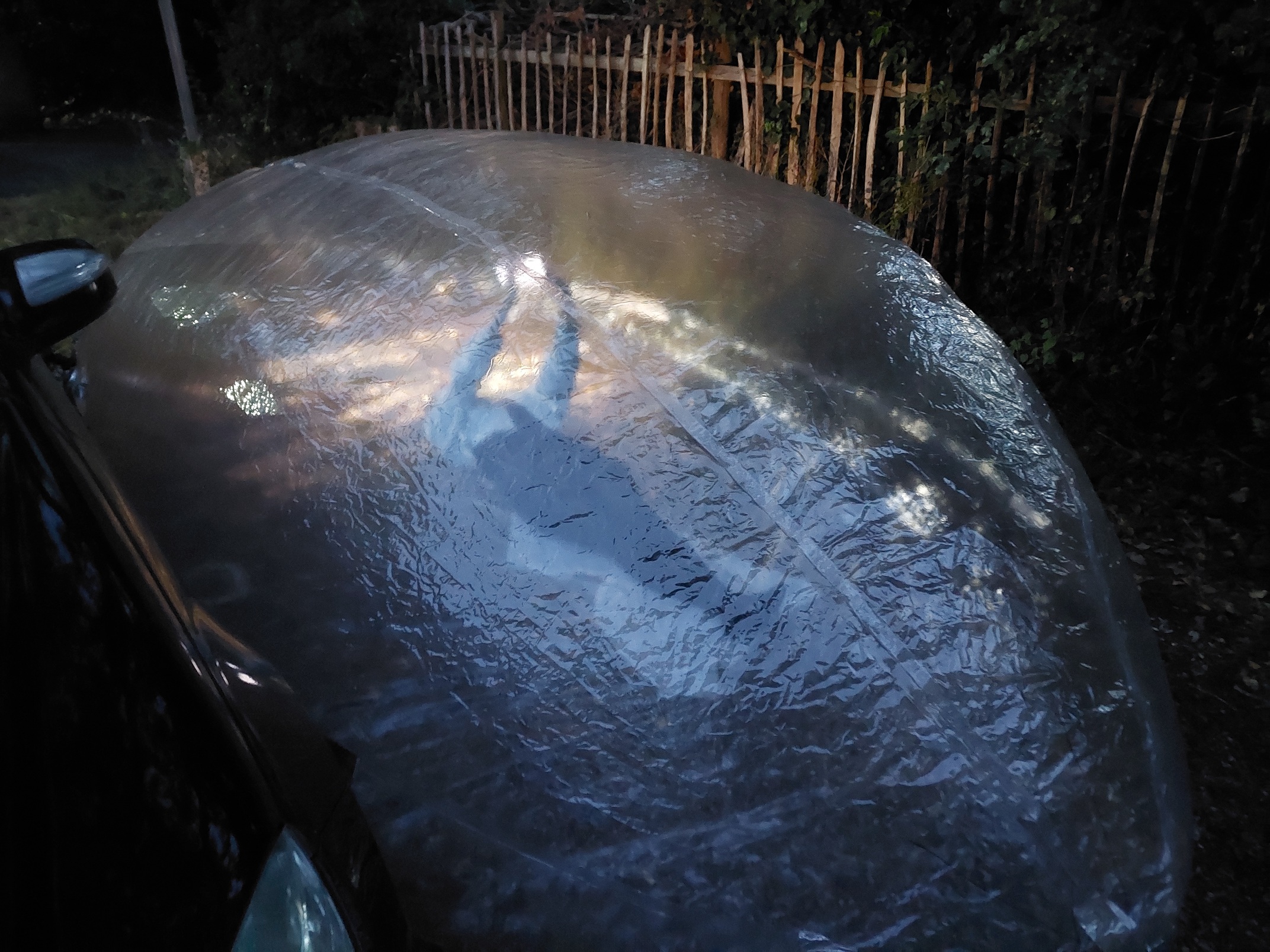
We ended up going to 3 Dunelms to get the around 60 m of PVC that we would need to construct the balloon. We would pull up, stride in, find the fabric desk, and ask to buy all of their PVC. Only once were we asked why we needed so much PVC and we answered truthfully.
The house I was living and working in had a living room but it was fairly small, less than 4 m across. This made building the 6 m long balloon difficult. After cutting the first three segments of six, which would come together to form the cohesive shape. We moved over to one of the university lecture halls where we had all of 10 m to work with. The difficulty with PVC was that it was fairly stretchy and although we could cut all the pieces from one pattern piece, it was quite difficult to keep the lines even across pieces.
Small ripples and offsets magnify as you weld out from the middle so that by the time you get to the all important ends there's about 5cm difference in piece lengths. You cut the piece back, increase the curve around the edge to make it the same length. The pieces match up, but now the curve is steeper on that side.
After I graduated, with Hannah in her second year, we finally had a good amount of time to make the final push to flight and I resolved that we would try and have it fly within two months.
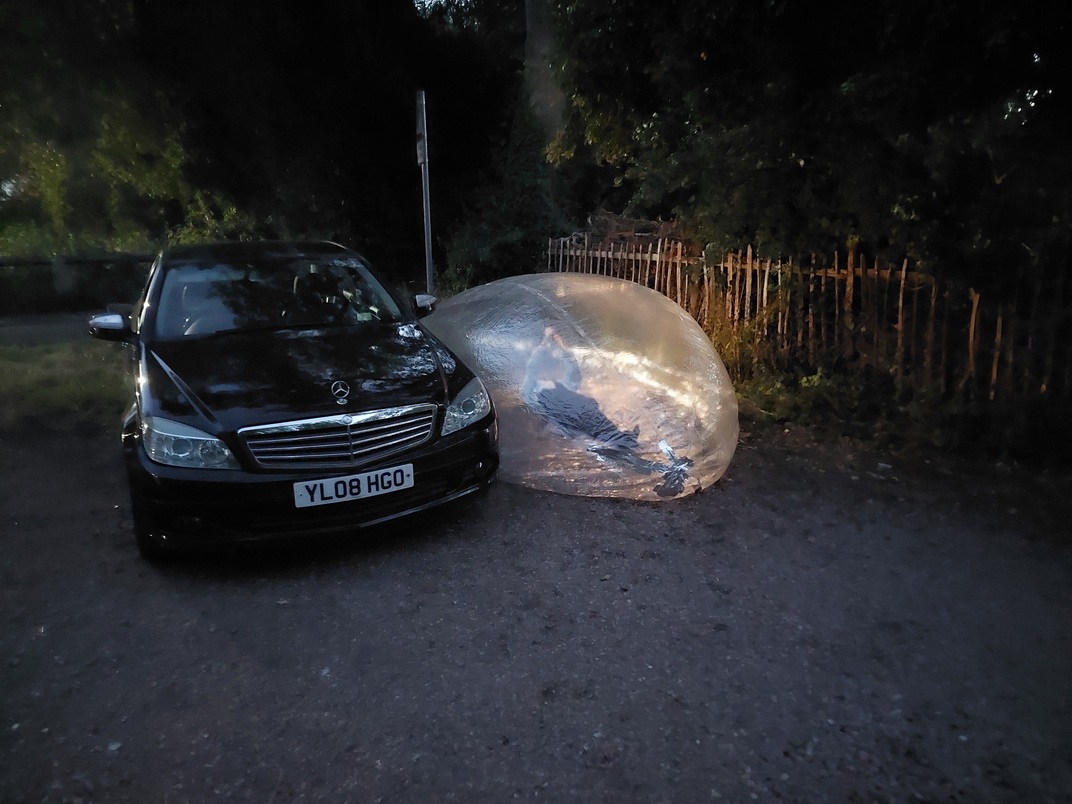
Approaching all of our cutout pieces after almost a year-and-a-half, we started to weld again. I purchased a second pair of hair straighteners and we both got to work.
When the envelope came together in the middle and we finished the aft with only the fore left to go, we tried our first test inflation. A piece of spare PVC was taped over the front and the bottom seam, which we had not yet welded so that we might insert an umbilical cord later on. We finished the final seems over the next few months. I ended up rebuilding the front to be a single circular piece rather than where the six segments connect. This created a much more cohesive front to the balloon.
That was still the issue of how we would connect the balloon to the ground, which we had been thinking about since we started the project. We had a number of disagreements about whether it was safe to connect the balloon to the car, a nearby tree, or some kind of ground anchor (massively over-estimating the lifting force we would be dealing with). Working out some details, it seemed like we would be able to tie the balloon onto the empty hydrogen tank and resolved that it would be possible to simply pull the balloon out of the sky when needed.
RISK ASSESMENT

==============


Fire on the ground

Keep all sparking or ignition devices at least 20m away. No smoking within the area. Keep a fire extringuisher ready at all times.


Fire in the air

Propper grounding of the balloon and its housing


Fire due to lighnting

Clear skies when flying the balloon


debis impacting people or property

keep people away


Collision with flying object

Flying always below 60m


Birdstrikes

?


Collision with power cables

keep balloon away from power lines


Collision with private propertly

keep away from houses and feilds, fly only in open access land


Becoming unterthered


innability to get the balloon down


Interferance from the public

In open access land

==============
We decided a length of blue rope would be sufficient tied off onto the envelope with a number of large plastic washers that we made from an old PVC tub sealed to the body of the balloon.
Losing the envelope, while it was full of hydrogen, was our biggest concern. Not only was it fairly large relative to a plane engine, but it was also made of clear PVC. To make matters worse, we would be flying at night to avoid the heat of the Sun melting our joints. I remember me and Hannah role-played our call to the FAA.
"Hello FAA, we've lost a blimp over the peaks"
"Okay, okay, filled with helium right?"
"Hydrogen"
"Oh, what color is it?"
"See-through"
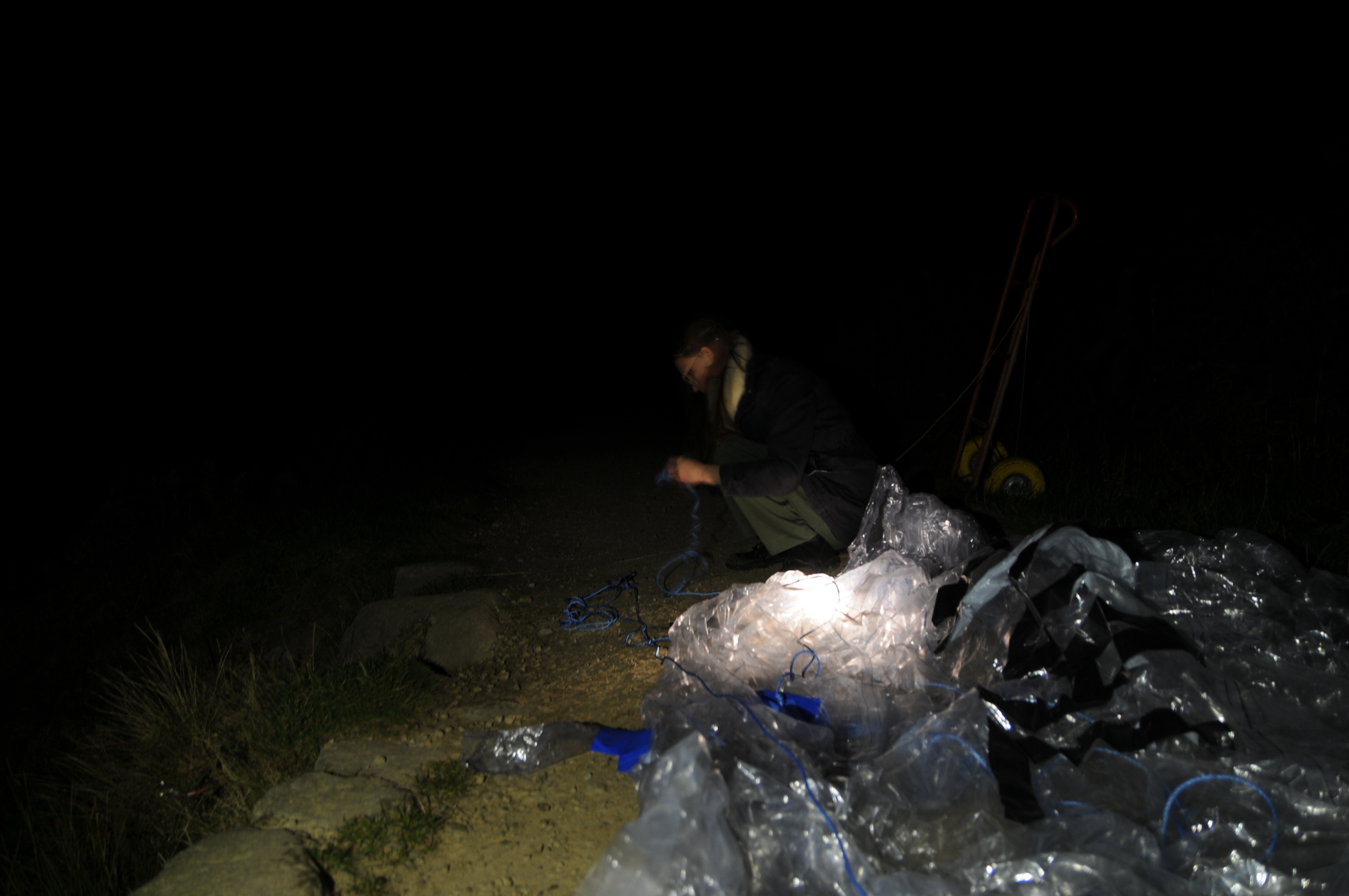
Hannah eventually came up with an amazing idea. Although one of the connecting ropes coming loose would, by necessity, tear a hole in the envelope and vis-a-vis begin deflating the balloon, we weren't sure that it would deflate fast enough to become safe. Hannah's idea was to tie all of the connecting ropes together inside the blimp, forcing all ropes to be pulled from the envelope before the envelope would be lost, guaranteeing enough opening to release the hydrogen before getting to open airspace.
To our surprise (having totally forgotten about the electrolysis idea) large tanks of hydrogen were readily available, cheap, and in the correct tank size to pretty much fill the entire balloon. We acquired the tank which was about 6 foot tall and manoeuvred it into Hannah's car.
The first day that we tried to fly the blimp we discovered that tank fittings come in two different types: for fuel gases, like propane; and other gases, shielding gases used in welding. Presumably this is to prevent people using fuel gases as shielding gases. Tanks have different handed threads on the insert depending on their contents. For shielding gases, it is a standard right hand thread, for fuel gases it is a reversed left-hand thread. The regulator that I had was for welding, meaning it was a right-hand (shielding gas) thread. Hydrogen is primarily used as fuel therefore it was a left-hand thread. For 10 minutes, me and Hannah took turns trying to get a right hand nut into a left hand thread.
I ordered a replacement tank nut with the left-hand thread and we tried again a week later.
|
Friday |
Saturday |
Sunday | |
|
Time |
12/09/25 |
13/09/25 |
14/09/25 |
|
00:00:00 |
Travel to site | ||
|
00:01:00 | |||
|
00:02:00 | |||
|
00:03:00 | |||
|
00:04:00 | |||
|
00:05:00 | |||
|
00:06:00 |
Police chase | ||
|
00:07:00 | |||
|
00:08:00 |
Will departs Elstree | ||
|
00:09:00 | |||
|
00:10:00 | |||
|
00:11:00 |
Will diverts Nottingham to Long Eaton |
Test inflation | |
|
00:12:00 |
Both arrive at boat |
Final prep | |
|
00:13:00 |
Glue and attach anchor ropes | ||
|
00:14:00 |
Fix lettering on side | ||
|
00:15:00 |
Press all seams | ||
|
00:16:00 |
Evalutate! |
Contingency to fix unseen issues | |
|
00:17:00 |
Contingency to fix unseen issues | ||
|
00:18:00 | |||
|
00:19:00 |
Travelling to Manchester | ||
|
00:20:00 | |||
|
00:21:00 | |||
|
00:22:00 | |||
|
00:23:00 |
Driving into the Peak District, with 60 kg of flammable hydrogen and the six meter long blimp, was very stressful. While we were on our way out of Manchester, we passed the flashing roadside light up sign that was about 3 m tall. It was flashing "beware of forest fires". It was the middle of November. And it was raining. After last weeks failure, I started yelling about how 'they' were trying to stop us.
It didn't help that because the tank was so long and Hannah seats didn't fall forward. My seat had to be far forward and tilted as much as possible. This meant that I was sitting cross-legged curled up facing down into the foot well. It was very uncomfortable.
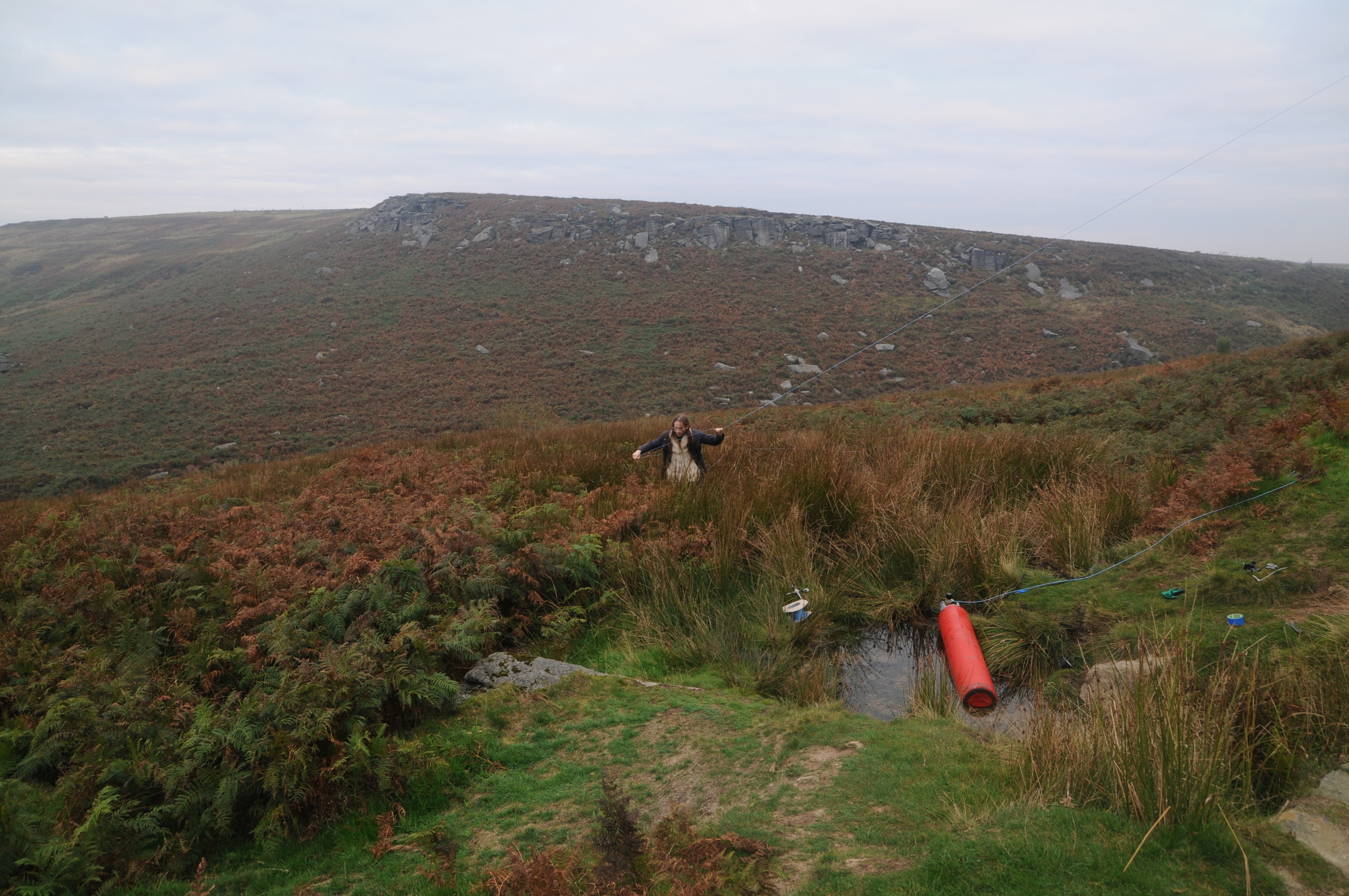
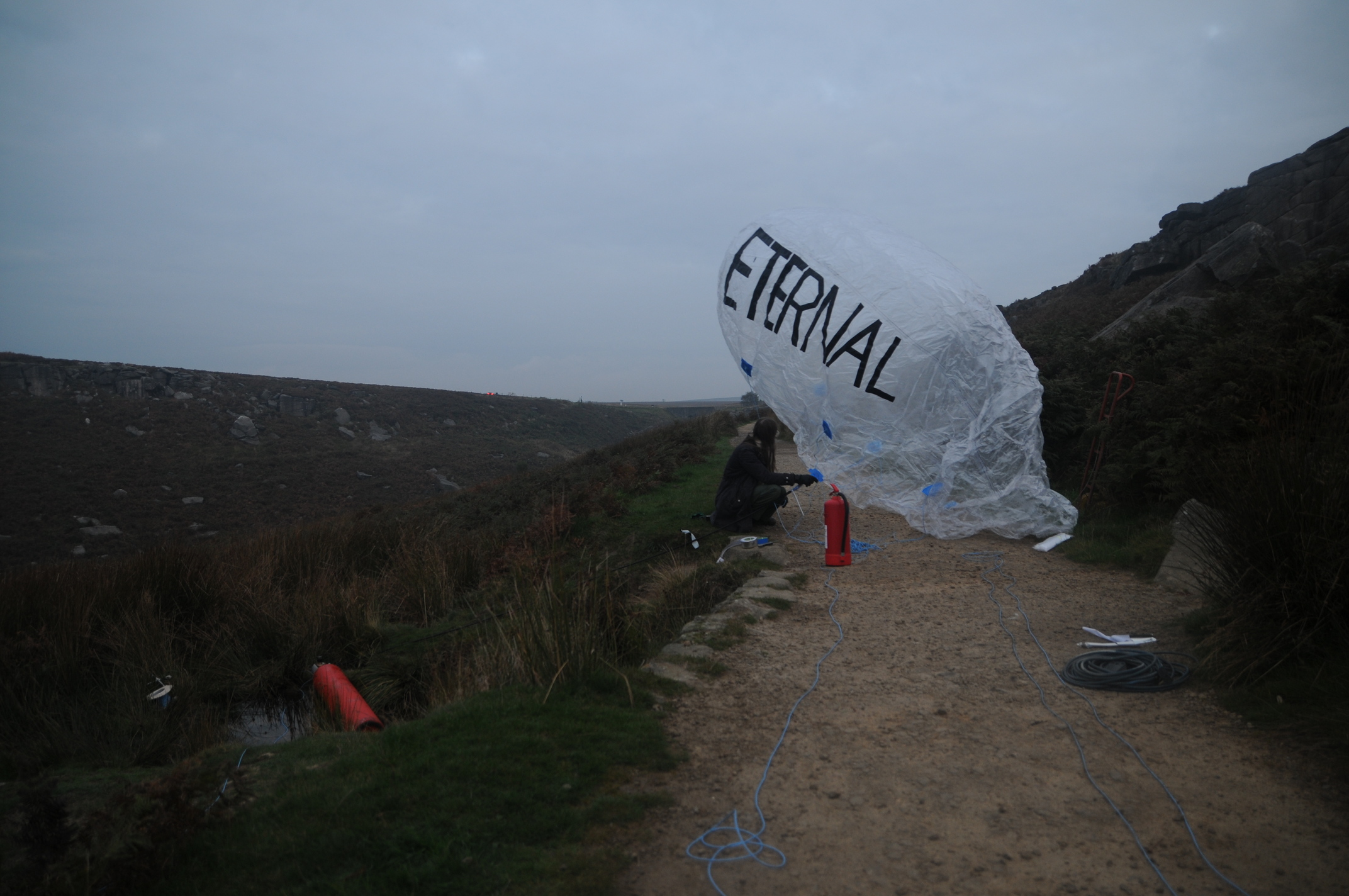
When we had the tank set up and ready to go, we begun the inflation. As a measure to prevent tank freezing, we threw the tank in a small pond which we had spotted on our earlier visit.
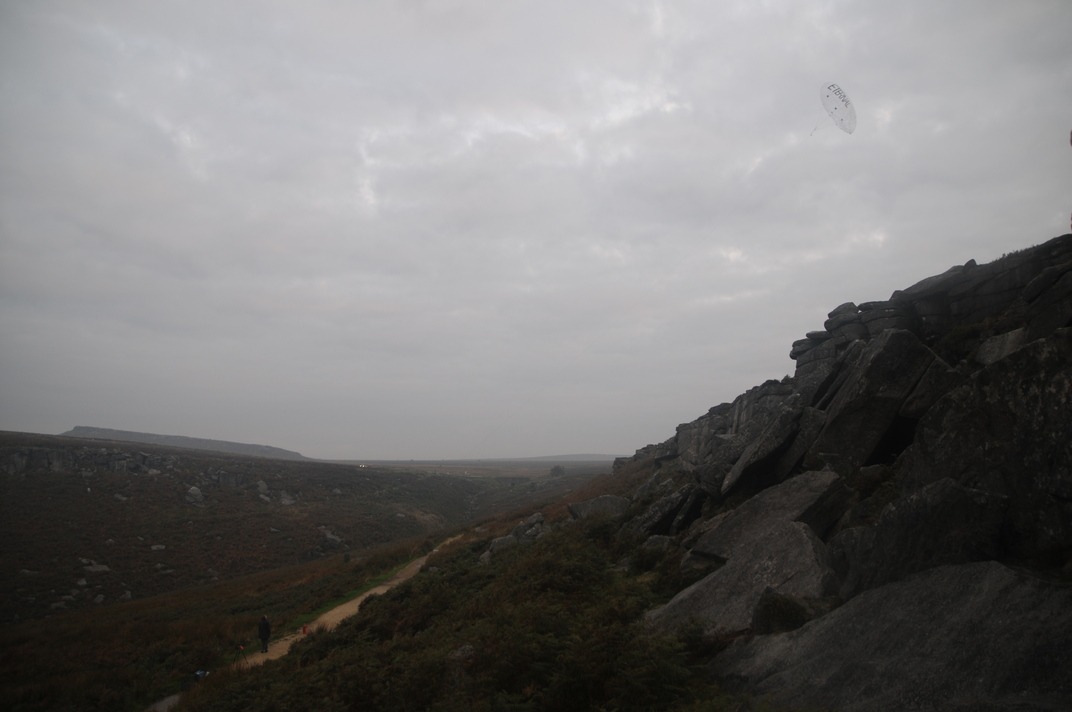
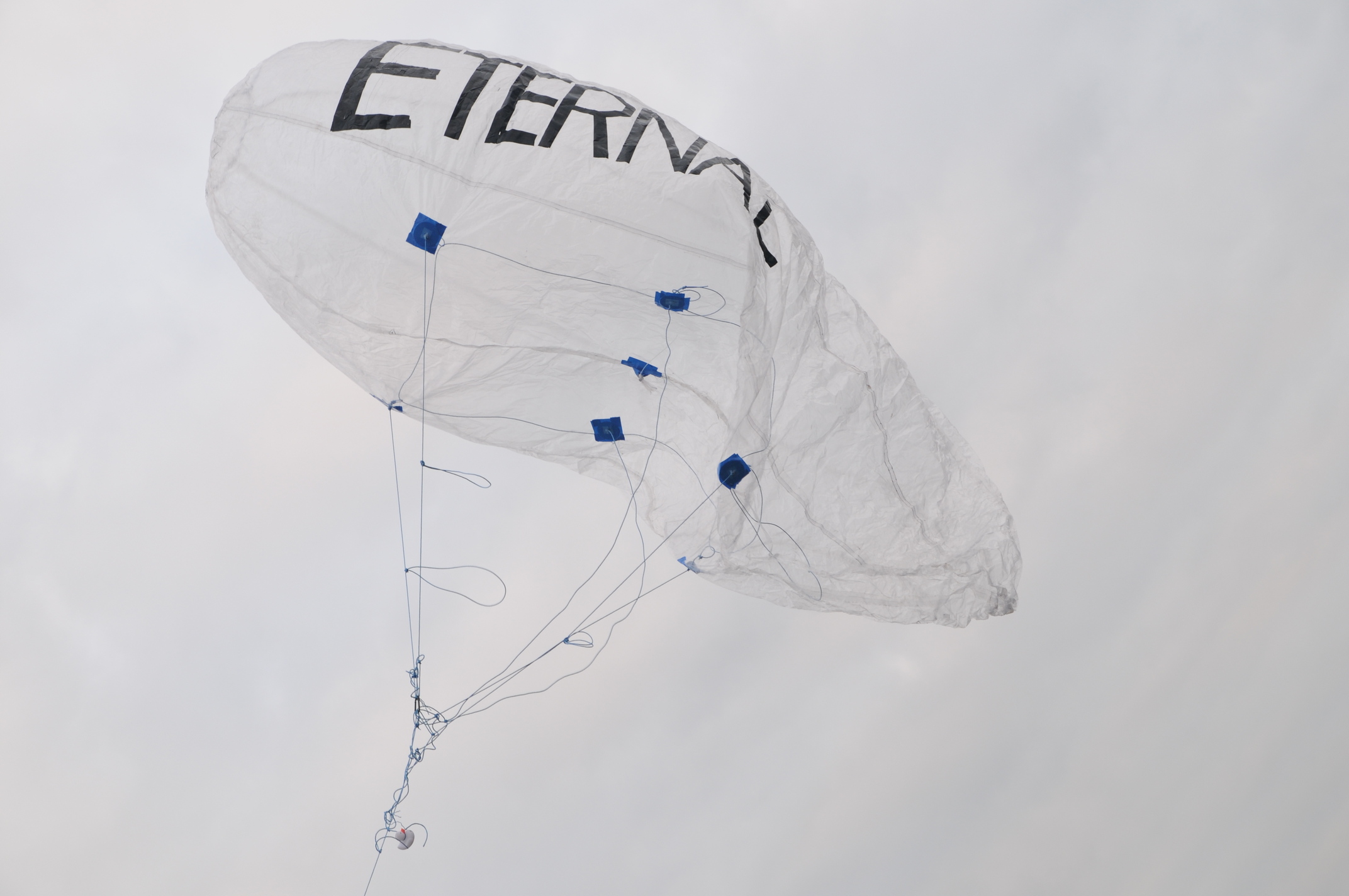
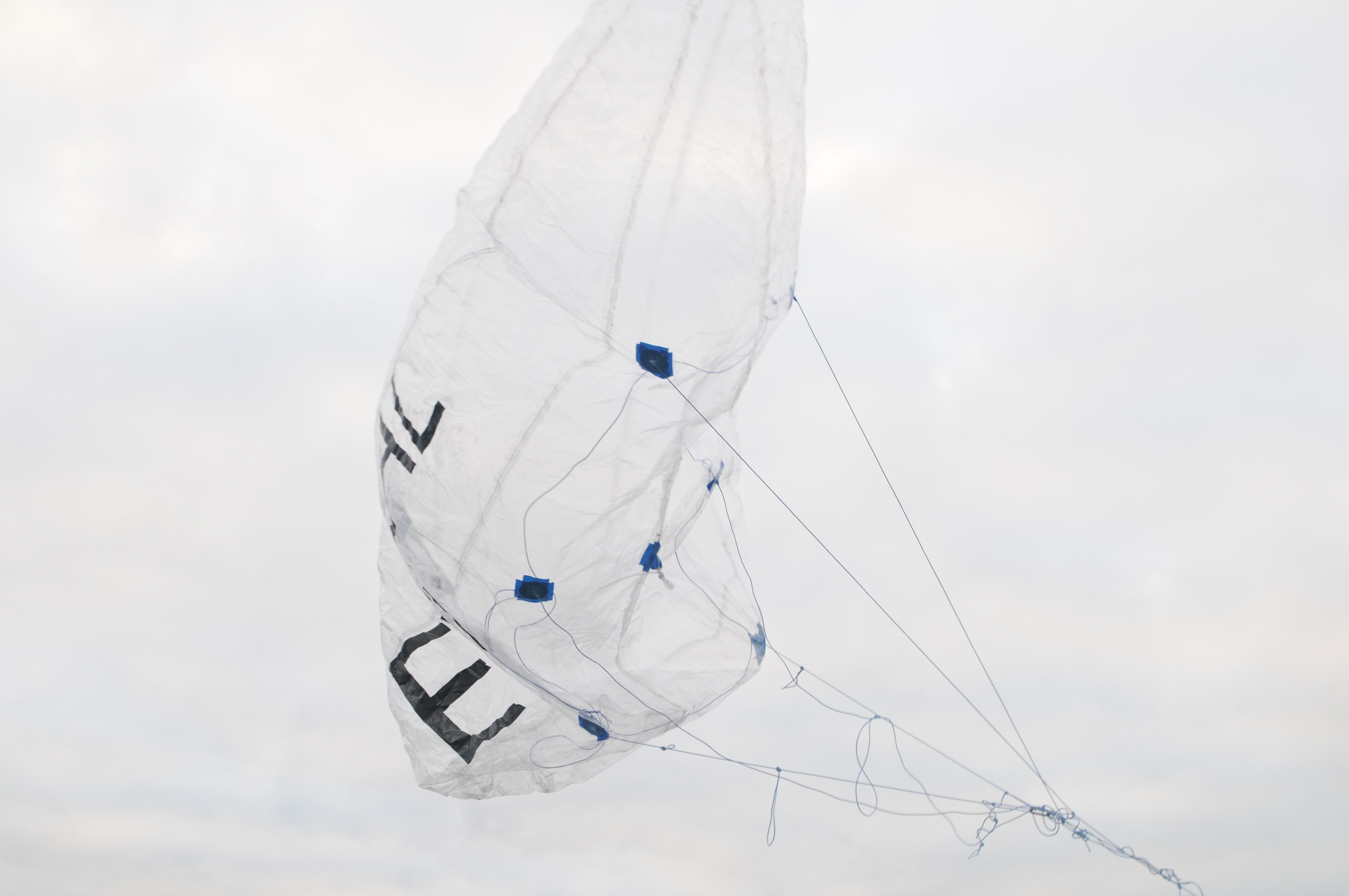
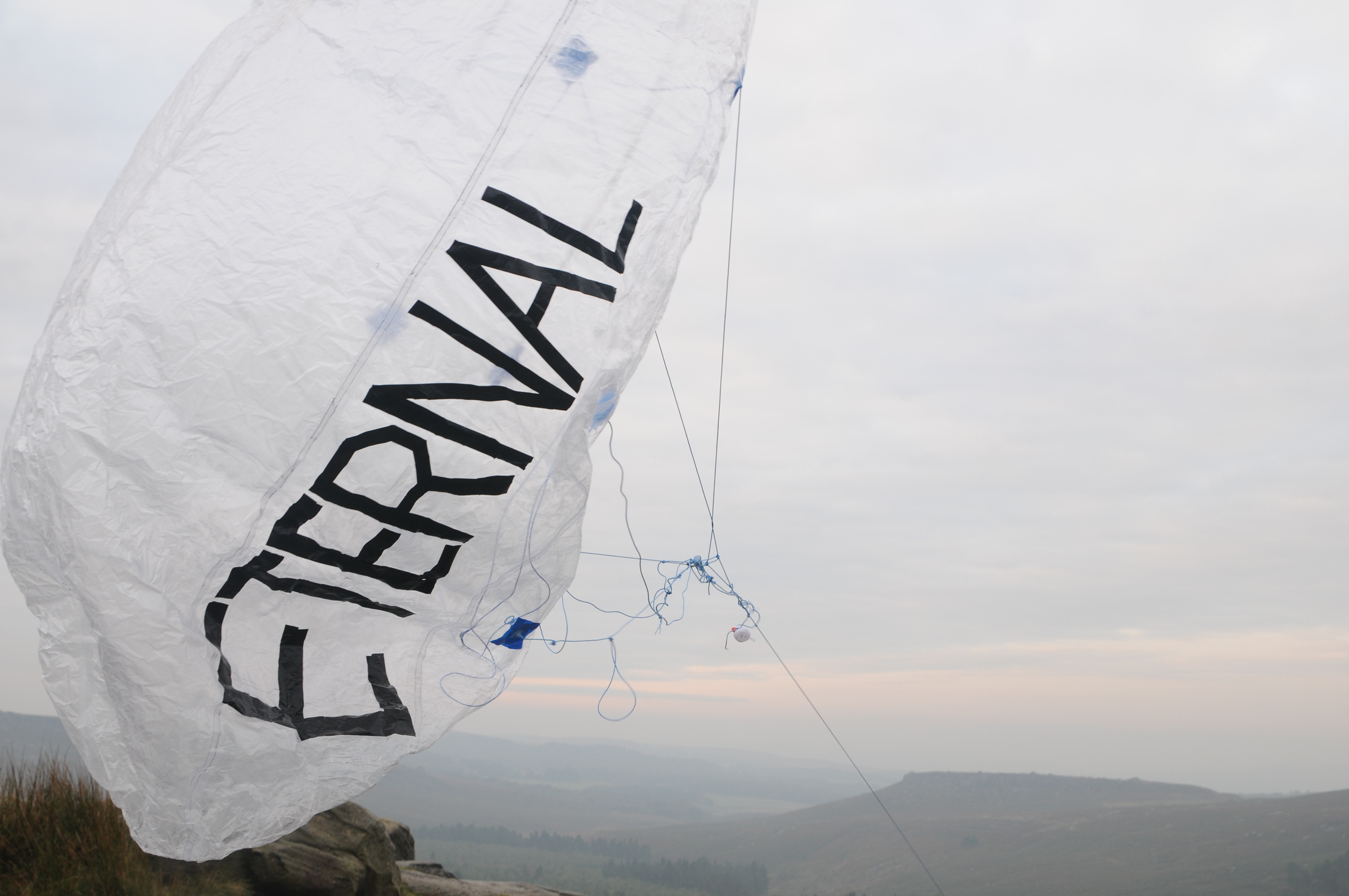
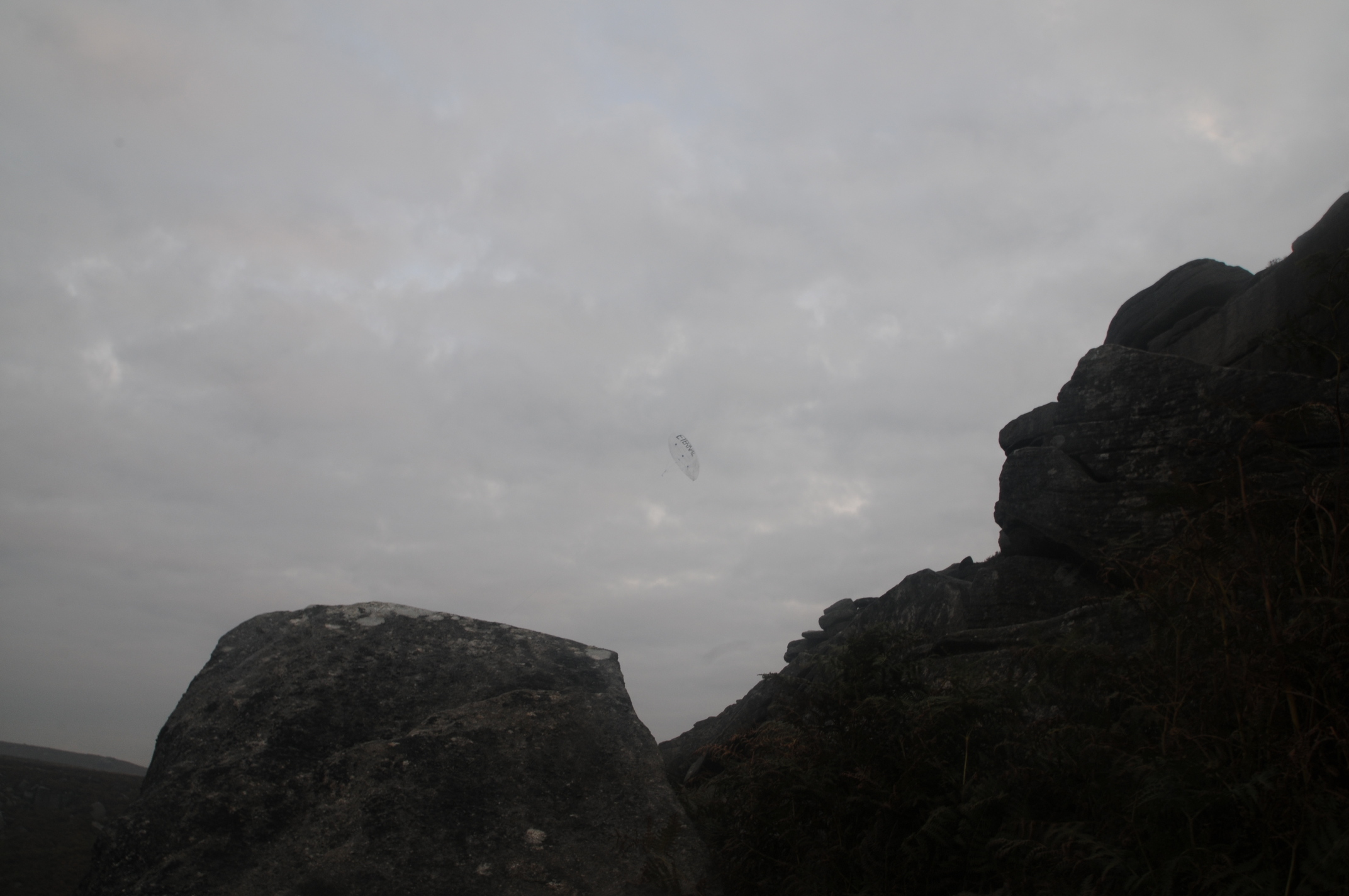
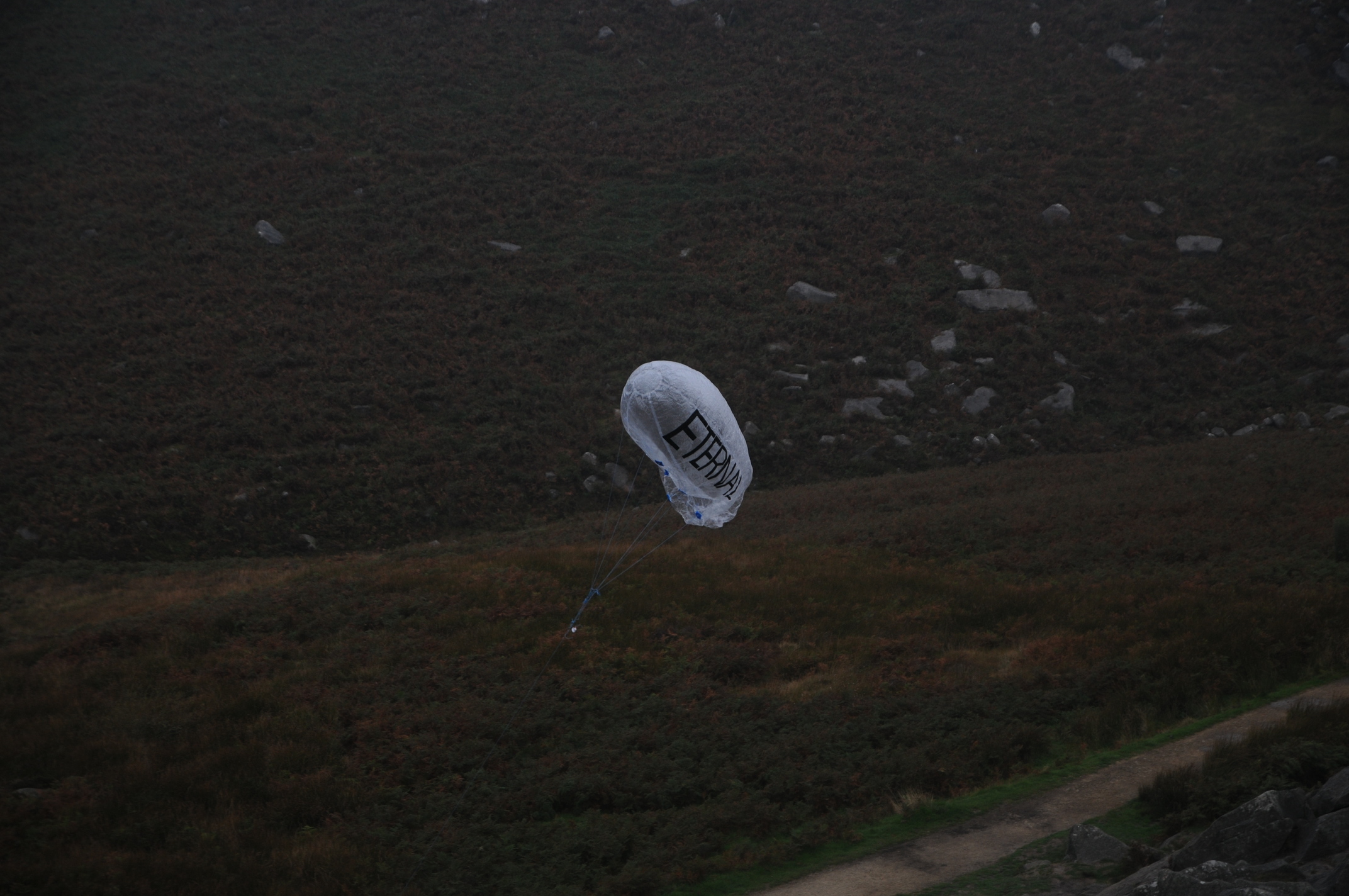
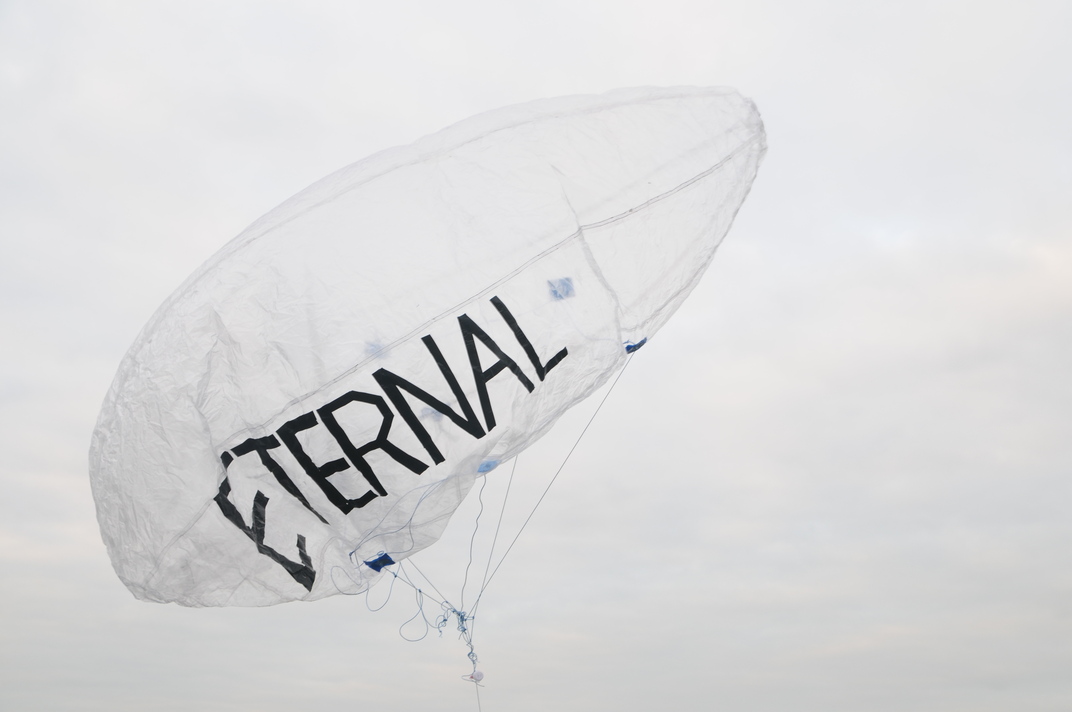
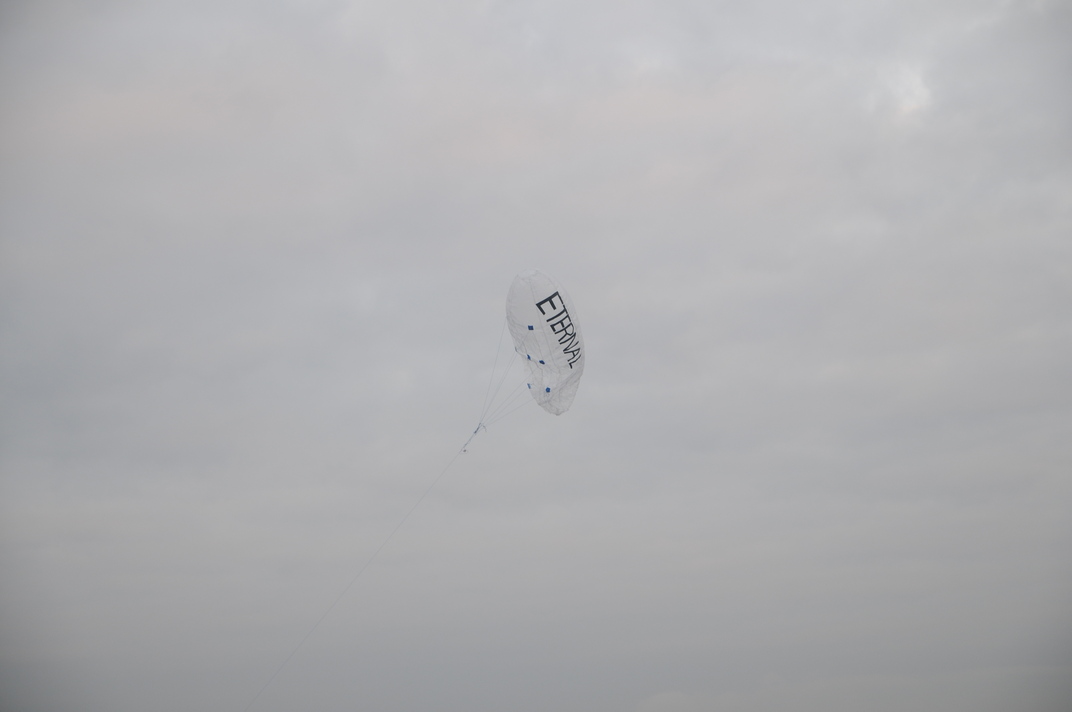
ETERNAL flew! And flew well, although the envelope was less full than I would've liked. It caught the wind like it was half of a sail and bent in half with the head facing upwards. The geometry of the tail and the lack of symmetry seem to change the relative internal pressure even within the envelope causing the head to be far more inflated than the tail. The text on the side of the balloon, "ETERNAL", looked beautiful and I got a number of amazing photos of the blimp flying over the peaks.
I think we both had the feeling that wasn't it weird that one is able to do this with 60 m of PVC and a tank of hydrogen? Our equipment was a tank regulator and a pair of hair straighteners we made it to the legal limit of how high you can fly a un-powered balloon.
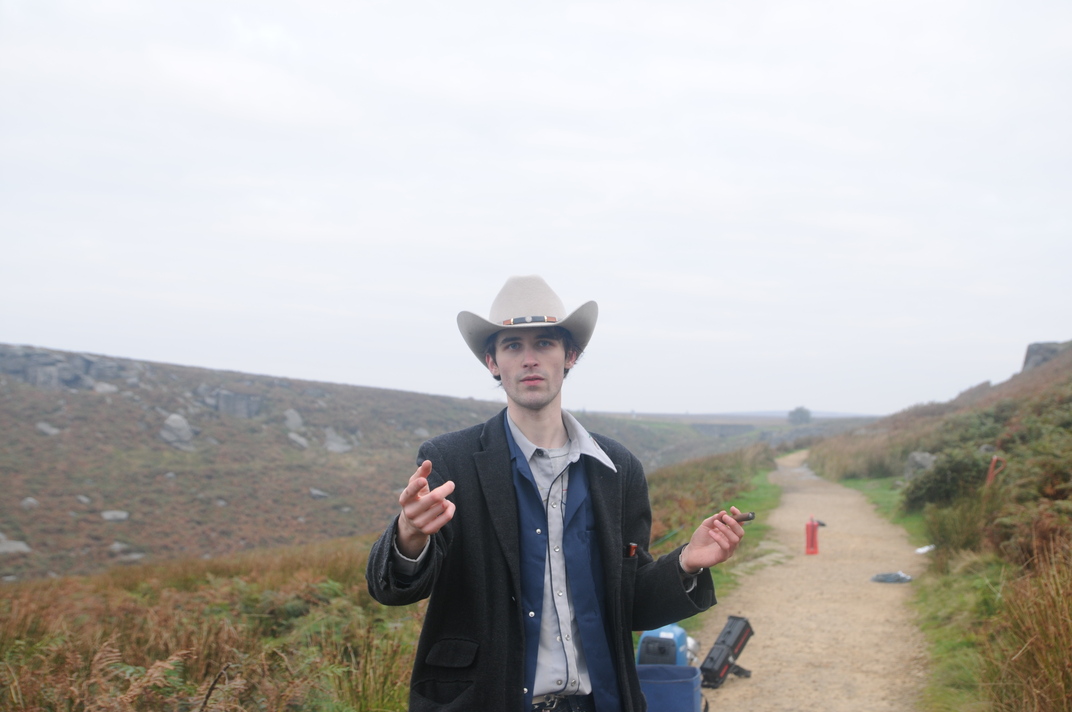
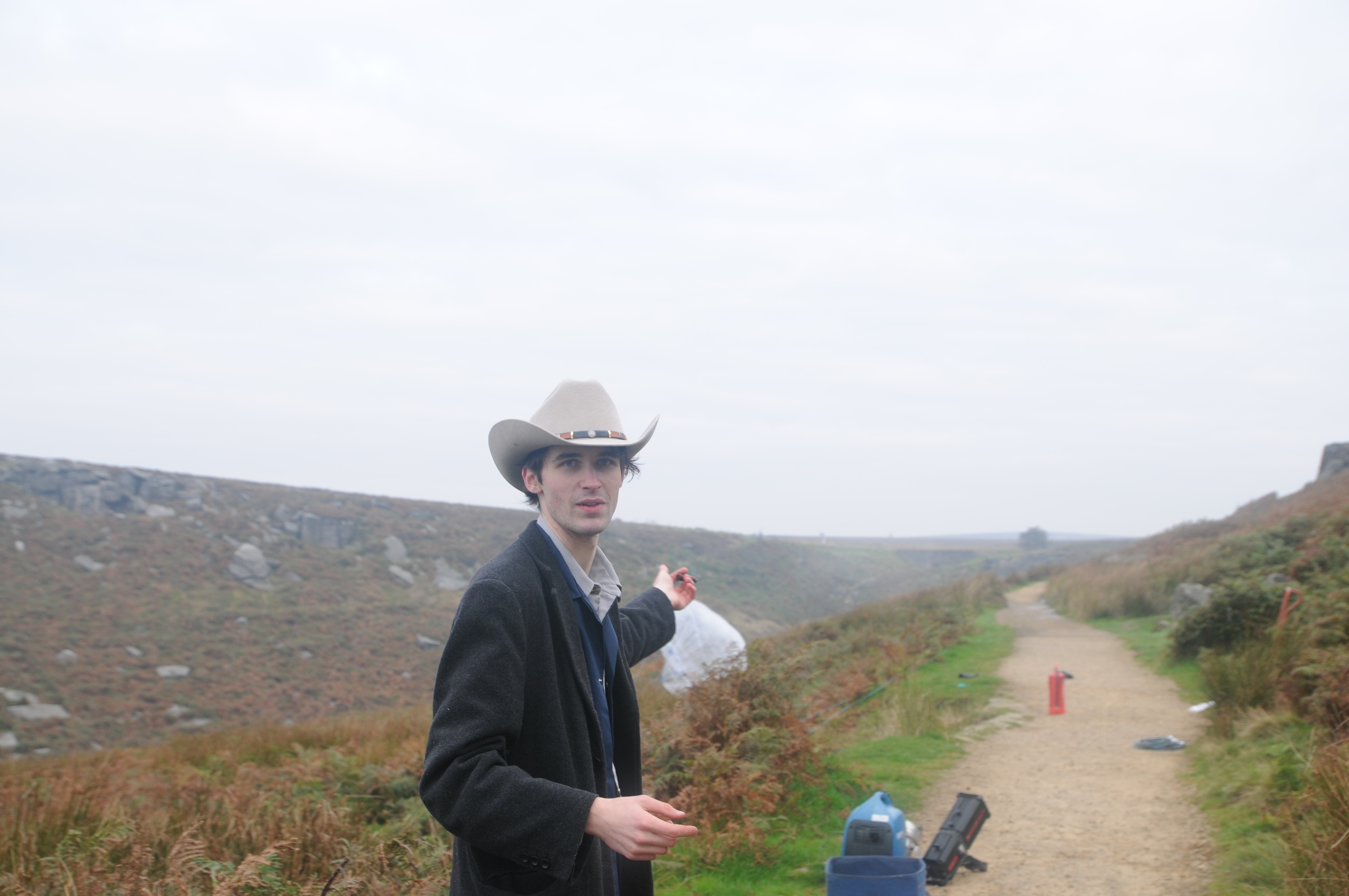
While the balloon was in the air, we smoked our cigars and took pictures. Hannah manoeuvred the balloon like she was manoeuvring a sail and flew it around the sky. When it began to drop, I ran over, took my multi-tool and sliced the body of the blimp. It felt like gutting a whale.
We packed the car. And went to go get breakfast.
Having intended to fly at night with two spotlights to light the photos, by the time we managed to get her up in the air it was dawn, even on a winter day. We ended up flying under the soft light of the grey November skies... I couldn't have asked for a better soft box.
Everyone I've told this story thinks I'm insane. But I remember my dad telling me he did something similar, but floated it on the sea, and I think back to Panamarenko: why couldn't it have worked? PVC is incredibly cheap, and so is hydrogen, there were logistical challenges but nothing expensive. Why not? The inclination is to assume that I'm some kind of blimp enthusiast, but really I don't care. I had the idea to build a blimp, I took it to Hannah, and then we did it. Everybody has ideas all the time that they don't act on, it seems like such a waste.
When I'm bouncing off the walls and manic I have a couple of sayings, things like "I'm going to live forever" or "I will not fail", I think that kind of energy is a very powerful thing. I think "ETERNAL" means the same thing as "I will live forever". It's a statement of extreme, insane, fanatic energy, that cannot be stopped. And it is ETERNAL.
It can't be stopped by Dunelm stock issues, it cannot be stopped by airline routes, it cannot be stopped by flammable fuels, I will not fail, and the blimp will fly. And it did.
© Will Greenwood 2025